
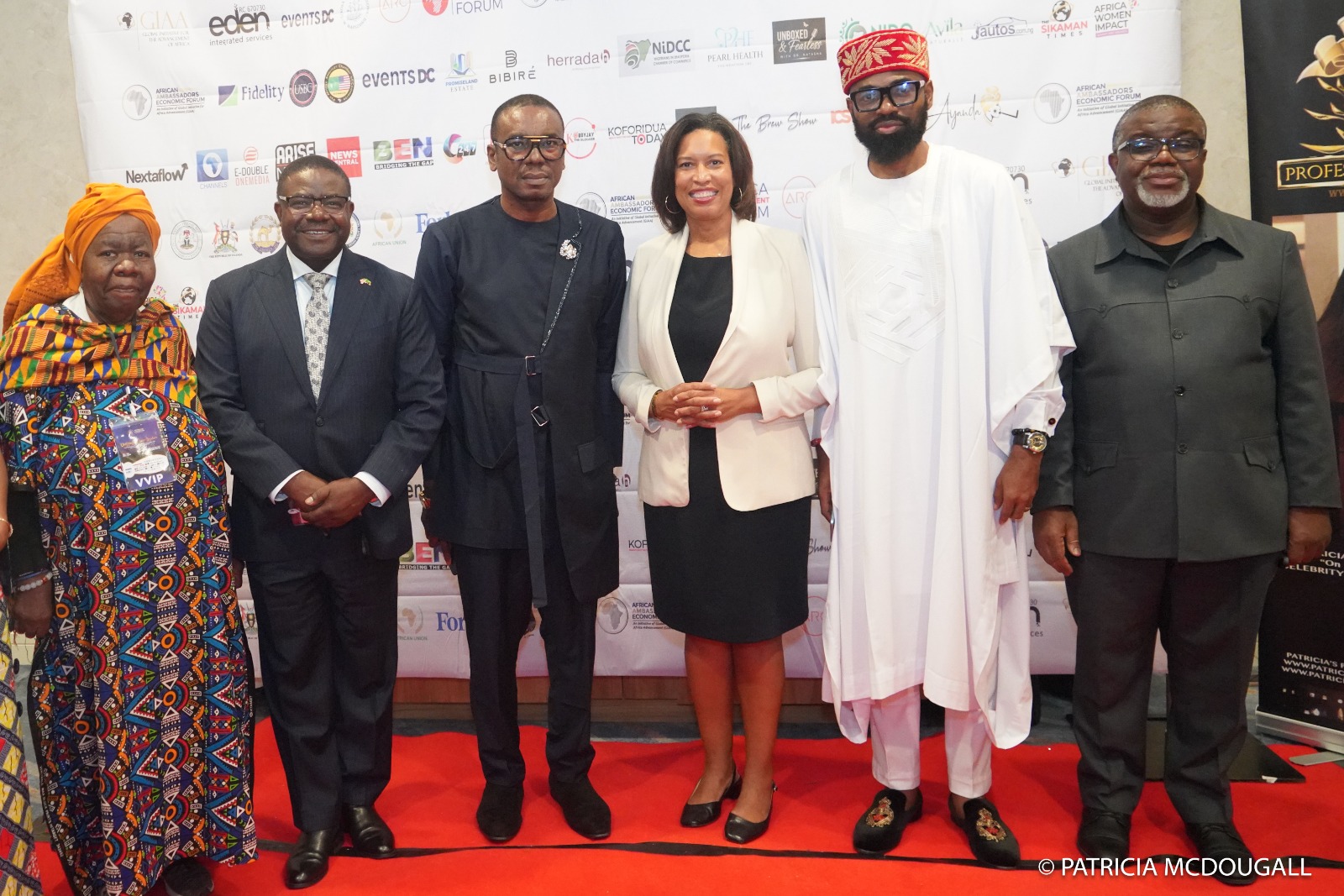
I recently read a remarkable interview granted by Dr. Ahunna Eziakonwa, Under-Secretary-General and Special Adviser on Africa to the United Nations Secretary-General, to the accomplished journalist and Public Relations Executive Toni Kan.
I found myself returning to one central idea from that conversation:
Africa is paying a price for how the world perceives its risk.

And I believe we need to have a much more uncomfortable conversation about this.
Dr. Eziakonwa’s intervention on Africa’s risk premium is particularly important because it forces us to confront a reality that has profound consequences for our development: the perception of risk is itself an economic cost.
When capital perceives Africa as excessively risky, Africa pays more to borrow, more to build and more to grow.
And ultimately, development itself becomes more expensive.
This is why I believe the proposed African Credit Rating Agency (AfCRA) deserves far more attention than it is currently receiving.
I commend Toni Kan for bringing this important conversation into the public domain, and I commend Dr. Ahunna Eziakonwa for articulating it with the intellectual clarity, courage and urgency that the subject deserves.
But as someone deeply engaged in the conversation around African trade, investment, diaspora capital and the continent’s relationship with global markets, I believe we must take the argument one step further.
AFRICA CANNOT CONTINUE TO OUTSOURCE THE PRICING OF ITS FUTURE.
For decades, the world’s major credit-rating institutions have played an enormous role in determining how investors perceive African countries, businesses and projects.
I am not suggesting that African countries should receive favourable ratings simply because they are African.
Absolutely not.
Africa does not need an institution that tells the world what we want to hear.
We need an institution capable of telling the world what Africa’s risk actually is.
That means rigorous analysis.
Independent methodologies.
Reliable data.
Professional integrity.
Institutional independence.
And the courage to tell African governments and businesses uncomfortable truths when the evidence demands it.
There is a profound difference between asking for a better rating and demanding a better assessment of reality.
That distinction is at the heart of this conversation.
WHOEVER DEFINES RISK HAS ENORMOUS POWER OVER CAPITAL.
Think about it.
A rating influences the cost of borrowing.
The cost of borrowing influences whether a project is bankable.
Bankability influences whether investors participate.
Investor participation influences whether infrastructure gets built.
And infrastructure determines, to a significant extent, whether economies can grow.
So when we talk about credit ratings, we are not talking about abstract financial terminology.
We are talking about roads.
Power.
Housing.
Manufacturing.
Technology.
Healthcare.
Agriculture.
Jobs.
And the ability of African businesses to scale.
This is why the conversation around AfCRA is much bigger than the creation of another ratings institution.
It is about who gets to participate in determining the price of Africa’s future.
AFRICA DOES NOT HAVE A SHORTAGE OF OPPORTUNITIES.
We have a shortage of affordable, appropriately structured and sufficiently patient capital to convert many of those opportunities into scalable assets.
Africa has entrepreneurs.
Africa has resources.
Africa has a young population.
Africa has enormous infrastructure needs.
Africa has expanding consumer markets.
Africa has technology and innovation.
Africa has a growing middle class.
Africa has an increasingly influential diaspora.
And Africa has extraordinary investment opportunities.
The question is:
Why is capital still so expensive relative to the opportunity?
This is where AfCRA becomes potentially transformational.
If it can establish global credibility, it could help create a more sophisticated understanding of African risk—one that distinguishes between countries, sectors, companies, projects and actual fundamentals rather than allowing broad assumptions about “African risk” to dominate investment decisions.
AND THIS IS WHERE I HAVE A STRONG POSITION.
Africa must move from being priced to participating in the pricing.
We cannot aspire to economic sovereignty while remaining dependent on external institutions to determine how the world prices our economies, our companies and our projects.
We need to build:
Our own data infrastructure.
Our own research capacity.
Our own financial intelligence.
Our own capital-market institutions.
Our own investment ecosystems.
And yes—
our own globally credible mechanisms for assessing risk.
This is entirely consistent with the broader aspiration of Agenda 2063: an integrated, prosperous Africa, driven by its own citizens and capable of becoming a powerful force in the global arena.
But let me make one thing very clear.
I WILL SUPPORT AFCRA—BUT NOT BECAUSE IT IS AFRICAN.
I will support it if it is excellent.
If it is independent.
If it is intellectually rigorous.
If it is transparent.
If it is professionally governed.
If its analysts cannot be intimidated by political power.
If its methodology can withstand scrutiny in Lagos, Nairobi, Johannesburg, London, New York, Singapore and every serious capital market in the world.
And if it is prepared to downgrade an African government, institution or company when the facts demand it.
African ownership must never become an excuse for compromised credibility.
Quite the opposite.
African ownership should mean that we build an institution so professionally credible that the world has no choice but to take its analysis seriously.
THE OPPORTUNITY IS MUCH BIGGER THAN CREDIT RATINGS.
Imagine what happens when investors can distinguish more accurately between real risk and mispriced risk.
Imagine infrastructure projects becoming bankable because their risks are better understood.
Imagine African corporations becoming more legible to international institutional investors.
Imagine deeper African bond markets.
Imagine more African pension and institutional capital being deployed into productive assets.
Imagine the African diaspora having more credible investment information upon which to make long-term decisions.
Imagine global investors looking at Africa not as one monolithic risk category, but as 54 markets with different fundamentals, different opportunities and different risk profiles.
That is the Africa I want to see.
Not an Africa asking the world for sympathy.
An Africa demanding analytical accuracy.
Not an Africa asking for cheaper money as a favour.
An Africa building the institutional architecture that earns cheaper capital.
Not an Africa waiting for the world to discover its opportunities.
An Africa making its opportunities investable.
THIS IS WHY THE CONVERSATION MATTERS TO ME PERSONALLY.
Through my work as Co-Founder & Managing Director of the Global Initiative for the Advancement of Africa (GIAA), I have had the privilege of engaging across the intersections of African trade, investment, policy, diplomacy, entrepreneurship and the global African diaspora.
GIAA exists around a simple conviction:
Africa’s transformation must increasingly be driven by strategic partnerships, investment, value-added trade, knowledge, innovation and the mobilisation of African and global capital—not dependency.
Our work has increasingly focused on creating platforms where policymakers, diplomats, investors, entrepreneurs, development institutions and members of the African diaspora can move beyond conversation into meaningful partnerships and economic action.
That is why the AfCRA conversation resonates so strongly with me.
Because capital mobilisation begins with confidence.
And confidence begins with credible information.
SO HERE IS MY CHALLENGE TO AFRICAN LEADERSHIP.
To our policymakers:
Will you protect AfCRA’s independence—even when its ratings become politically inconvenient?
To our investors:
Will you help build the data and market infrastructure necessary for African risk to be assessed intelligently?
To our banks and financial institutions:
Will you support deeper African capital markets?
To our entrepreneurs:
Will you build businesses capable of meeting global standards of transparency and governance?
To the African diaspora:
Will we move beyond remittances towards strategic investment and ownership?
And to global investors:
Are you prepared to reassess Africa when better information challenges long-held assumptions?
Because here is my position:
AFRICA DOES NOT NEED THE WORLD TO RATE US KINDLY.
AFRICA NEEDS THE WORLD TO RATE US ACCURATELY.
And if we can build institutions capable of delivering that accuracy, we can begin to change not only the narrative around Africa—
but the economics of investing in Africa.
My appreciation to Dr. Ahunna Eziakonwa for putting this issue so forcefully on the global agenda, and to Toni Kan for creating the platform for that important conversation.
The debate must now move beyond whether Africa deserves better ratings.
The real question is whether Africa is ready to build the institutions, data, governance and credibility required to command a more accurate price for its future.
I believe we are.
But belief alone is not enough.
We must build.
We must institutionalise.
We must invest.
And we must own more of the architecture through which Africa’s economic future is financed.
I would genuinely like to hear from African policymakers, investors, bankers, CEOs, development-finance practitioners and members of the global African diaspora:
DO YOU BELIEVE AFRICA IS READY TO TAKE A GREATER ROLE IN PRICING ITS OWN RISK—and, ultimately, ITS OWN FUTURE?
Let’s debate it.
Dr. David James Egwu, PhD, MBA
Co-Founder & Managing Director, Global Initiative for the Advancement of Africa (GIAA)
Pan-African Trade, Investment & Development Advocate | Africa–Global Capital & Diaspora Engagement | Strategic Partnerships & Policy Dialogue
#Africa #AfCRA #AfricanCreditRatingAgency #FinancialSovereignty #AfricaRising #AfricanCapital #Investment #DevelopmentFinance #CapitalMarkets #PanAfricanism #DiasporaInvestment #Trade #AfCFTA #AfricaInvestment #Agenda2063